How to charge a car battery
A 12V charger's charge time in hours is roughly the battery's amp-hours needed times 1.2, divided by the charger's amps; a fully dead 50Ah battery on a 10-amp charger like the NEXPEAK 10Amp Smart Charger at $25.99 takes roughly 6 hours to fully charge.
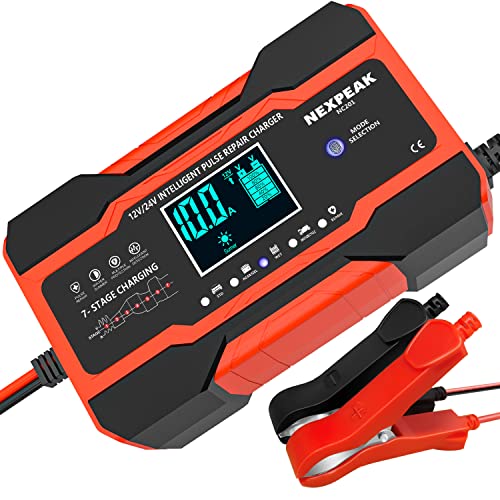
10Amp Battery Charger Smart Car Trickle Charger 12V 24V Battery Maintainer
10A
The main piece of gear for this job. The rest of what you need is below.
How to charge a car battery (step by step)
- Turn off the vehicle and remove the key from the ignition; disconnect the battery from the car if you are charging it outside the vehicle.
- Check the battery for cracks, leaks, or excessive swelling before connecting a charger; do not charge a damaged battery.
- Connect the charger's red, positive, clamp to the battery's positive terminal, then the black, negative, clamp to the negative terminal or a bare metal ground point if charging in the vehicle.
- Make sure the area is ventilated, since a charging lead-acid battery can vent a small amount of hydrogen gas.
- Select the correct voltage, 12V for most passenger vehicles, and, if the charger has selectable amperage, choose a lower amp setting for a slower, gentler full charge or a higher setting for a faster charge.
- Let the charger run until it indicates a full charge or automatically switches to maintenance mode; disconnect black first, then red.
How long does charging actually take?
The rough formula is: charge time in hours equals the amp-hours needed to replace, times 1.2 to account for charging inefficiency, divided by the charger's amp rating. A battery that needs 40 amp-hours restored on a 10-amp charger like the NEXPEAK 10Amp Smart Charger takes roughly 4.8 hours, while the same battery on a slower 2A charger like the NOCO GENIUS2D at $39.95 takes roughly 24 hours.
A higher amp charger is not always better for the battery's long-term health; slower charging generally puts less stress on the battery's plates, which is part of why many chargers marketed as smart chargers taper their charging rate down as the battery approaches full.
What is the difference between a charger and a maintainer?
A charger is meant to actively restore a low or dead battery's charge over a period of hours. A maintainer, sometimes called a trickle charger, is meant to sit connected long term, delivering a small trickle of current that keeps an already-charged battery topped off without overcharging it, useful for a car that sits unused for weeks at a time. Many modern units, like the CTEK 56-865 at $58.82 or the NOCO GENIUS10 at $94.95, do both jobs in one unit: they charge a low battery and then automatically switch to a maintenance mode once it is full.
What amp setting should I use?
Check the battery's own amp-hour rating, often printed on its label, and the charger's manual for its recommended maximum charge rate for that battery size before choosing the highest amp setting available.
- 2 to 6 amp chargers: gentler, slower, better suited to smaller batteries like motorcycle or powersports batteries, or for occasional top-offs
- 10 amp chargers: a reasonable middle ground for most passenger car batteries needing a meaningful charge
- 15 to 25 amp chargers: faster charging for a larger battery or when time matters, generally with a smart charging profile to avoid overcharging
Can I charge a car battery in the winter?
Yes, but never charge a battery that is frozen, meaning one that has been sitting in extreme cold long enough for the electrolyte inside to freeze, since charging a frozen battery risks the case cracking or worse. If a battery has been sitting in freezing temperatures for an extended period, let it warm to closer to room temperature before connecting a charger.
How do I know when the battery is fully charged?
Most modern smart chargers show a charge percentage or a series of indicator lights and will automatically taper down and switch to a maintenance or float mode once the battery reaches full charge, so you do not have to guess or manually disconnect at the right moment. If using a basic, non-smart charger without an auto shut-off, a resting battery reading close to 12.6V after the charger is disconnected and the battery has rested for a while indicates a full charge.
Chargers for restoring a low or dead battery
Prices change often.



Frequently asked questions
How long does it take to charge a completely dead car battery?
Using amp-hours needed times 1.2, divided by charger amps: a typical 50Ah battery fully dead on a 10-amp charger takes roughly 6 hours, while the same battery on a slower 2-amp charger takes roughly 30 hours. A higher amp charger cuts the time but is not always the gentlest option for the battery.
Can I leave a battery charger connected overnight?
With a smart charger that automatically switches to maintenance or float mode once full, yes, this is exactly what many of these chargers are designed for. With a basic charger lacking an auto shut-off, leaving it connected past a full charge risks overcharging the battery, so check the charger's own specs for an auto shut-off feature before leaving it unattended.
Is it safe to charge a car battery while it is still connected in the vehicle?
Generally yes for most modern vehicles, as long as you clamp the ground lead to a bare metal chassis point rather than directly on the battery terminal, and the charger is a standard 12V unit matching the vehicle's system. Some vehicles with sensitive electronics recommend disconnecting the battery first; check your owner's manual if unsure.
Why does my charger show it is finished but the battery still seems weak?
A charger reaching full on its display means it has restored the battery's charge, not that the battery's underlying capacity is still good. An older battery can accept a full charge and still lack the capacity to hold that charge or deliver enough current under load; a battery load test, separate from a charge, is the way to check actual health.
What amp charger should I use for a small motorcycle or powersports battery?
A lower amp charger, generally in the 1 to 3 amp range, like the Battery Tender Junior at $37.95, matches a small battery's lower capacity better than a 10 amp or higher automotive charger, which can push current faster than a small battery is rated to safely accept.
Can I charge a lithium car battery the same way as a lead-acid one?
Not with the same charger profile. A lithium battery needs a charger specifically rated for LiFePO4 chemistry, such as the NEXPEAK 15A Battery Charger listed for 12V/24V LiFePO4 at $39.99, since lead-acid charging profiles use different voltage curves that can undercharge or stress a lithium battery over time. Check the battery's own chemistry before assuming any 12V charger will do.