Tire pressure in cold weather
Tire pressure drops roughly 1 PSI for every 10 F the air temperature falls, so a tire set to 32 PSI in warm weather can read closer to 27 PSI after a 50 F overnight temperature drop, which is enough to trigger a low tire pressure warning light.
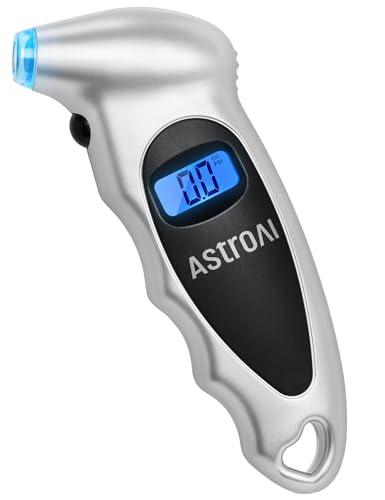
AstroAI Digital Tire Pressure Gauge 150PSI, ±1PSI Accuracy for Car Truck
150 PSI
The main piece of gear for this job. The rest of what you need is below.
Why does cold weather lower tire pressure?
Tire pressure is really air pressure, and air contracts as it cools, which lowers the pressure reading inside a sealed tire even though no air has actually leaked out. The relationship is roughly linear: tire pressure changes about 1 PSI for every 10 F change in air temperature. A tire holding 35 PSI on a 70 F day can read closer to 31 PSI once overnight temperatures drop to 30 F, a 40 F swing, without any air having escaped.
This is why a tire pressure warning light often comes on with the season's first genuinely cold morning even though nothing is actually wrong with the tire itself.
How much pressure will I actually lose in a cold snap?
Using the roughly 1 PSI per 10 F rule: a 20 F drop costs about 2 PSI, a 40 F drop costs about 4 PSI, and a 60 F drop, a realistic swing between a warm afternoon and a cold night in some climates, costs about 6 PSI. Applied to a tire set at the common passenger car target of 32 PSI, a 60 F drop can leave a tire reading closer to 26 PSI, meaningfully under target and often enough to trip a low pressure warning.
Should I inflate my tires to a higher pressure before winter?
The better approach is to set tires to the recommended cold pressure listed on the door jamb sticker whenever the temperature is genuinely cold, meaning close to what the tire will sit at most mornings through the season, rather than intentionally overinflating in warm weather to compensate for an expected drop later. Overinflating now and letting temperature swings correct it back down to target is an unreliable way to hit the right number and risks an overinflated tire on any unusually warm day.
Checking pressure regularly through the cold season, ideally with a digital gauge on a cold morning before driving, and topping off with a portable inflator as needed is the more reliable habit than a single seasonal adjustment.
How often should I check tire pressure in cold weather?
- At the start of a cold snap, since that is when the biggest single pressure drop happens
- Roughly monthly through a cold season even without a specific temperature swing
- Any time the tire pressure warning light comes on
- Before a long drive, especially one that crosses into colder or warmer regions
Does the same temperature effect reverse in warm weather?
Yes, the relationship runs both directions. A tire set to the correct cold pressure on a cold morning will read higher once the day warms up and the tire itself heats from driving, which is expected and not a sign of overinflation; tire pressure should always be checked and set when the tire is cold, meaning before driving or after it has sat for a few hours, rather than after a drive has warmed the air inside it.
Do front and rear tires need the same cold weather adjustment?
The door jamb sticker often lists a different recommended cold pressure for the front and rear axles, sometimes by several PSI, especially on vehicles that carry more weight over one axle than the other. Cold weather affects both axles by roughly the same 1 PSI per 10 F rule, so a front tire recommended at 32 PSI and a rear tire recommended at 29 PSI will each drop a similar amount in a cold snap, just from different starting points.
This means checking and topping off each axle to its own listed number, rather than setting all four tires to a single pressure, matters just as much in cold weather as it does the rest of the year. A digital gauge that reads out to a single PSI, like the ETENWOLF T300 at $7.55, makes it easier to hit each axle's specific target rather than eyeballing a number on an analog dial.
What you need to stay on top of cold weather pressure
Prices change often.

 AstroAI L7 Tire Inflator Portable Air Compressor,150 PSI Cordless Bike Pump150 PSI / cordless$23.49Check price on Amazon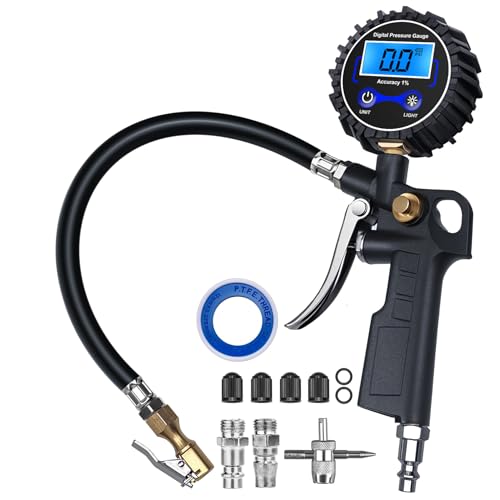

Frequently asked questions
How much does 1 degree Fahrenheit change tire pressure?
Roughly 0.1 PSI, based on the general rule that tire pressure changes about 1 PSI per 10 F of temperature change. Over a larger swing, like 30 or 40 degrees between a warm afternoon and a cold morning, that adds up to 3 to 4 PSI, enough to matter for handling and to trigger a warning light.
Why did my tire pressure light turn on overnight with no obvious cause?
A sharp overnight temperature drop is the most common cause of a tire pressure light appearing with no actual leak, since air pressure inside a sealed tire falls as the air cools. Check the actual PSI with a gauge before assuming a puncture; if all four tires dropped a similar amount, cold weather is the likely explanation.
Should I inflate tires higher than recommended before winter?
No. Set tires to the pressure listed on the door jamb sticker at whatever temperature you are actually checking them, and recheck regularly through the cold season rather than intentionally overinflating in advance, which risks an overinflated tire on any unexpectedly warm day.
Does cold weather affect all four tires the same amount?
Generally yes, since ambient temperature affects the air inside each tire similarly, assuming similar starting pressures. If one tire has dropped noticeably more than the others, that points toward a slow leak rather than the cold weather effect alone, and is worth checking with a gauge and a visual inspection.
What is the best time of day to check tire pressure in cold weather?
Before driving, ideally first thing in the morning after the car has sat overnight, since that is when the tire is at its coldest and gives the most accurate baseline reading. Checking pressure after even a short drive can show a higher number as the tire warms from friction with the road.
Can a portable inflator be used to top off tires in freezing temperatures?
Yes, a portable inflator works the same way regardless of outside temperature; it is simply adding air, not adjusting for temperature itself. Keep the unit itself somewhere reasonably warm between uses if possible, since very cold storage can temporarily reduce a cordless unit's battery performance, though this does not affect a 12V plug-in inflator drawing power from the running car.