Best digital tire pressure gauges
The JACO ElitePro is marketed for professional accuracy up to 100 PSI and costs $29.90, making it the pick for anyone who wants a gauge more precise than a basic budget model.

JACO ElitePro Digital Tire Pressure Gauge - Professional Accuracy - 100 PSI
100 PSI
The JACO ElitePro Digital Tire Pressure Gauge is explicitly marketed for professional accuracy and reads up to 100 PSI for $29.90, a range that comfortably covers every passenger car and most light truck tire pressures. A dedicated gauge like this is worth carrying alongside an inflator's built-in reading, since it is a single-purpose tool built around accuracy rather than added to a compressor as a secondary feature.
The three tiers
Beginner: Best cheap tire pressure gauge
Who it is for: Drivers who just want a basic digital reading in the glovebox for a few dollars.
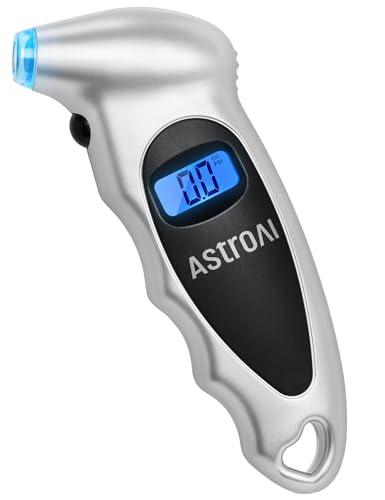 Beginner pickAstroAI Digital Tire Pressure Gauge 150PSI, ±1PSI Accuracy for Car Truck150 PSI$6.58Check price on Amazon
The AstroAI Digital Tire Pressure Gauge reads up to 150 PSI with a stated plus or minus 1 PSI accuracy for $6.58, covering the core job of a quick, readable pressure check at one of the lowest prices in this category.
Not for: If you also want an inflator function built into the same tool, look at the DigitPro option below instead.
Intermediate: Best gauge with built-in inflator
Who it is for: Drivers who want to check pressure and add air with a single tool.
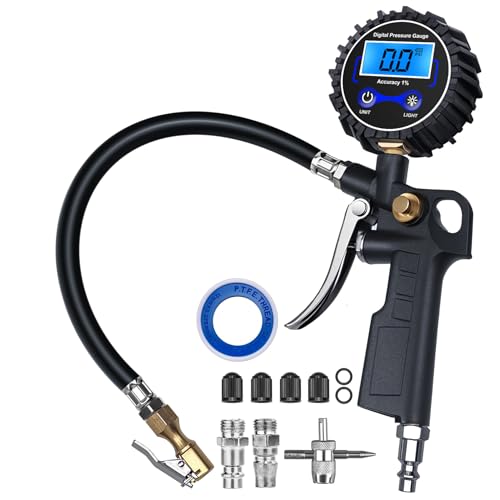 Intermediate pickDigitPro Digital Tire Pressure Gauge with Inflator 3-250 PSI Heavy Duty250 PSI$16.99Check price on Amazon
The DigitPro Digital Tire Pressure Gauge with Inflator reads 3 to 250 PSI and adds an inflation function for $16.99, useful for drivers who want one compact tool that both measures and corrects a low tire rather than carrying a gauge and a separate pump.
Not for: If you already carry a dedicated portable inflator, a gauge-only unit like the JACO ElitePro is more compact and purpose-built for accurate readings alone.
Expert: Best wide-range gauge for trucks and trailers
Who it is for: Owners who also check larger truck, trailer, or commercial tires running above passenger car pressures.
 Expert pickAstroAI Heavy Duty Digital Tire Pressure Gauge 0-230 PSI230 PSI$20.98Check price on Amazon
The AstroAI Heavy Duty Digital Tire Pressure Gauge reads 0 to 230 PSI for $20.98, a wider ceiling than the 100 to 150 PSI gauges above, useful for anyone whose tires occasionally run into higher pressure ranges than a standard passenger car.
Not for: If you only ever check standard passenger car tires at 30 to 40 PSI, this wider range is unnecessary and the JACO ElitePro's stated accuracy focus is the better fit.
| Model | Price | Key spec | Best for |
|---|---|---|---|
| AstroAI 150PSI | $6.58 | ±1 PSI accuracy, 150 PSI range | Cheapest reliable gauge |
| ETENWOLF T300 | $7.55 | 200 PSI range | Wider range on a budget |
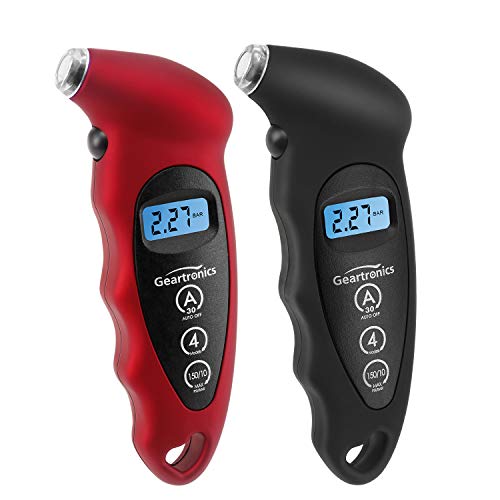
| Geartronics 150PSI | $9.99 | Backlit LCD, 4 settings | Easier low-light reading |
| ETENWOLF T300 2-Pack | $15.16 | 200 PSI range, two gauges | Keeping one in each vehicle |
| DigitPro with Inflator | $16.99 | 3-250 PSI, gauge plus inflator | Gauge and top-off in one tool |
| AstroAI Heavy Duty | $20.98 | 0-230 PSI range | Larger truck or trailer tires |
| JACO ElitePro | $29.90 | Professional accuracy, 100 PSI | Most precise reading |
How accurate does a tire pressure gauge need to be?
Most passenger car tires are sensitive to differences of just a few PSI, since even 1 to 2 PSI off from the manufacturer's recommendation can measurably affect handling, tread wear, and fuel efficiency. Gauges stating a specific accuracy figure, like the AstroAI's plus or minus 1 PSI, give you a documented margin of error, while gauges without a stated accuracy figure leave that unknown.
The JACO ElitePro's marketing around professional accuracy is the clearest accuracy claim in this lineup, which is why it is the topPick for buyers who want confidence in the number they are reading.
What PSI range do I actually need?
Passenger car tires typically run 30 to 40 PSI, so any gauge in this list, even the 100 PSI JACO ElitePro, covers that range with plenty of margin. Larger truck, trailer, or commercial tires sometimes run higher pressures, in which case a wider-range gauge like the AstroAI Heavy Duty (0-230 PSI) or DigitPro (3-250 PSI) is the safer choice.
Check your specific tire's sidewall maximum pressure before assuming a 100 PSI gauge covers every tire you own.
Does temperature change my tire pressure reading?
Yes. Tire pressure changes by roughly 1 PSI for every 10 degrees Fahrenheit of air temperature change, which means a tire correctly set in a warm garage can read noticeably lower once outside temperatures drop. This is a property of the air inside the tire, not a flaw in the gauge itself.
Check pressure when tires are cold, meaning the vehicle has not been driven for at least a few hours, and use the tire pressure temperature calculator to adjust your target reading for the season.
How we chose
Every gauge here was researched from published Amazon specifications and verified owner reviews, not hands-on bench testing against a calibrated reference. We compared stated PSI range, any explicit accuracy claim, and whether the tool combines a gauge with an inflator function or stays gauge-only.
We favored gauges with an explicit accuracy statement, like the AstroAI's plus or minus 1 PSI or JACO's professional-accuracy marketing, over listings that state only a PSI range with no accuracy figure. Prices reflect the listed amount at time of writing.
Buying tips
Should I buy a gauge-only tool or one with a built-in inflator?
A gauge-only tool like the JACO ElitePro or basic AstroAI keeps the design focused on accurate reading. A combo tool like the DigitPro saves a separate purchase if you also want a basic inflation function, though the inflator side is usually less powerful than a dedicated portable inflator.
Do I need a backlit display?
A backlit display, like the Geartronics gauge above, makes checking pressure in a dim garage or at night noticeably easier to read. It is a convenience feature rather than one that changes the gauge's core accuracy.
Why do I need a higher PSI range if my car tires only need 30-40 PSI?
A wider PSI range, like the AstroAI Heavy Duty's 0-230 PSI or the DigitPro's 3-250 PSI, matters if you also check truck, trailer, or commercial tires that run well above passenger car pressures. If you only ever check standard car tires, a 100 to 150 PSI range gauge covers the job with margin to spare.
Other options across the price range
An even spread from budget to premium. Prices change often.



Frequently asked questions
How often should I check my tire pressure?
A common recommendation is at least once a month and before any long trip, since tires lose air gradually over time and pressure shifts with temperature. Checking when tires are cold, meaning the car has not been driven recently, gives the most accurate reading against your target PSI.
Why does my tire pressure warning light come on even when I just filled the tires?
Temperature swings can drop pressure by roughly 1 PSI per 10 degrees Fahrenheit, which can trigger a tire pressure monitoring system if you filled tires in a warm garage and then drove into colder outside air. Check the tire pressure temperature calculator to see how much adjustment to expect for the season.
What is the difference between a digital and analog tire pressure gauge?
A digital gauge displays a numeric readout directly, generally easier to read precisely than an analog dial or stick gauge, especially at low light. Digital gauges do rely on a small battery, so keep a backup or spare battery on hand if you depend on one regularly.
Can I use the same gauge on my car and a bicycle or trailer?
Check the PSI range and valve type compatibility first; a gauge rated for typical car pressures (up to 100 or 150 PSI) may not read accurately on a road bike tire that runs well above that range, and trailer tires sometimes use different valve stem fittings than a standard car tire.
Is a gauge with a built-in inflator less accurate than a gauge-only tool?
Not necessarily less accurate, but combo tools split their design between two functions, while a gauge-only tool like the JACO ElitePro is built around precise measurement as its single purpose. If accuracy is the top priority, a dedicated gauge is the more focused choice.