Best 4K dash cams
The REDTIGER F7NP ($149.98) is the best 4K dash cam for most drivers, with a 4K front camera, a STARVIS 2 sensor, a rear camera, and a card included.

REDTIGER F7NP 4K Dash Cam Front Rear, STARVIS 2 Sensor, Free Card Included
4K / 2 channel
The REDTIGER F7NP records true 4K on the front camera with a STARVIS 2 sensor, adds a rear camera, and ships with a memory card, all for $149.98. That combination of a modern sensor and a bundled card at this price is what puts it ahead of similarly priced 4K options.
The three tiers
Beginner: Best cheap 4K pick
Who it is for: a buyer who wants true 4K front and rear coverage for under $120
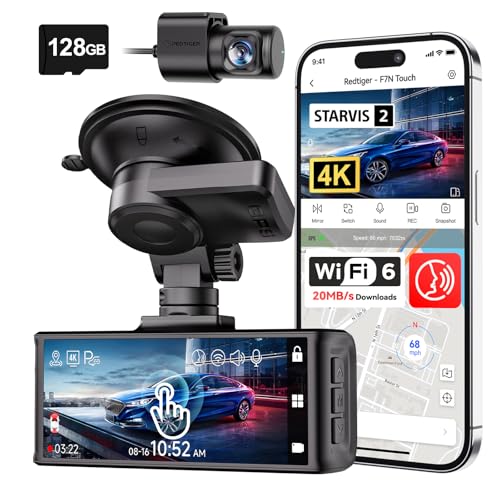 Beginner pickREDTIGER 4K STARVIS 2 Dashcam Front Rear, 5GHz WiFi 20MB/s, Free 128GB Card4K / 2 channel / Wi-Fi$119.99Check price on Amazon
The REDTIGER 4K STARVIS 2 Dashcam records 4K front and rear with a STARVIS 2 sensor, 5GHz WiFi, and a 128GB card, for $119.99. It matches the sensor generation of models costing $100 or more above it, which makes it the best entry point into true 4K rather than a marketing-only 4K claim.
Not for: buyers who want GPS or a touchscreen, since neither is listed on this model.
Intermediate: Best 4K pick with a bundled card and proven sensor
Who it is for: someone who wants a settled, well-reviewed 4K sensor without shopping for a card separately
 Intermediate pickROVE R2-4K Dual Dash Cam Front and Rear, STARVIS 2 Sensor, Free 128GB Card4K / 2 channel$149.99Check price on Amazon
The ROVE R2-4K Dual records 4K front video on a STARVIS 2 sensor and includes a 128GB card, for $149.99. ROVE has kept this exact spec combination in market long enough to build a track record, which matters for firmware updates on a camera you plan to keep for years.
Not for: buyers who want WiFi transfer to a phone, since WiFi is not listed on this model.
Expert: Best premium 4K pick for both channels
Who it is for: a driver who wants dual STARVIS 2 sensors, meaning both the front and rear camera use the newer sensor generation, plus HDR
 Expert pickVIOFO A229 Pro 4K HDR Dash Cam Front and Rear, Dual STARVIS 2 Sensors4K / 2 channel$279.99Check price on Amazon
The VIOFO A229 Pro records 4K HDR video on both the front and rear camera, each built on a dual STARVIS 2 sensor, for $279.99. Running the newer sensor on both channels, not just the front, is what separates this tier from cheaper 4K dual-channel kits where only the front camera gets the upgraded sensor.
Not for: budget shoppers, and for anyone who wants a memory card included, since this listing does not bundle one.
| Model | Price | Key spec | Best for |
|---|---|---|---|
| REDTIGER 4K STARVIS 2 Dashcam | $119.99 | 4K front + rear, STARVIS 2, WiFi, 128GB card | Cheapest true 4K dual pick |
| REDTIGER F7NP | $149.98 | 4K front + rear, STARVIS 2, card included | Overall best value |
| ROVE R2-4K Dual | $149.99 | 4K front + rear, STARVIS 2, 128GB card | Bundled card, proven sensor |
| REDTIGER F17 4K 3CH | $159.99 | 4K 3 channel, STARVIS 2, 5.8GHz WiFi, 64GB card | Adding a cabin camera in 4K |
| VIOFO A229 Pro | $279.99 | 4K HDR front + rear, dual STARVIS 2 sensors | Best sensor on both channels |
| THINKWARE ARC900 | $389.99 | 4K front + 2K rear, dual STARVIS 2, GPS, HDR | Premium pick with GPS |
| BlackVue DR970X Box Plus | $504.99 | 4K front + full HD rear, 64GB card included | Flagship brand, card included |
What does 4K actually get you on a dash cam?
4K resolution on the front camera means about four times the pixel count of 1080p, which shows up most clearly when you zoom into a still frame to read a license plate or a street sign after an incident. At normal playback size the difference between 4K and 1080p is subtle; the value of 4K is almost entirely in how far you can zoom in after the fact.
4K comes with a bitrate cost. A typical 4K stream runs about 32 Mbps, compared to about 16 Mbps for 2K and about 12 Mbps for 1080p. That higher bitrate fills a memory card faster and puts more demand on the card's write speed, which is why high-endurance cards matter more on a 4K camera than on a 1080p one.
Do I need 4K on the rear camera too?
Usually not. A following vehicle is typically much closer to the rear camera than the subjects a front camera needs to resolve at a distance, so a 1080p or 2K rear channel is normally enough to read a following car's plate. Reserving 4K for the front camera and using a lower resolution on the rear is a common way manufacturers cut the combined bitrate without giving up the detail that matters most, and it is why the THINKWARE ARC900 pairs a 4K front camera with a 2K rear camera instead of running 4K on both.
How much memory card space does a 4K dash cam need?
A single 4K front channel at 32 Mbps fills roughly 11 hours on a 128GB card by itself. Add a 1080p rear channel at about 10 Mbps, for a combined 42 Mbps, and that same 128GB card holds about 6.3 hours before the loop starts overwriting old footage. Stepping up to a 256GB or 512GB high-endurance card roughly doubles or quadruples that runtime on the same camera.
How we chose
This page was researched from published manufacturer specifications and verified owner reviews on the retail listings, not hands-on testing. We only included cameras whose listing specifications state a 4K resolution on at least the front channel, since some listings market a lower resolution as 4K in the title without stating it in the specifications.
We noted separately whether the rear or cabin channel also runs at 4K, since several strong picks in this category, including the THINKWARE ARC900, intentionally keep the front channel at 4K while running the rear channel at a lower resolution to manage bitrate and card usage.
Buying tips
Is 4K worth the extra memory card usage?
For the front camera, yes, since 4K is what makes zoomed-in plate and sign text usable evidence rather than a blur. Budget for a high-endurance card of at least 128GB, and plan on 256GB or larger if you want more than a few hours of buffer before old footage loops over.
Does 4K need a faster card than 1080p?
Yes. A 4K stream at roughly 32 Mbps needs sustained write speed that a slow or non-endurance-rated card can struggle to keep up with, which shows up as dropped frames or corrupted files. Stick to cards explicitly rated for dash cam or continuous-recording use.
Front-only 4K or front-and-rear 4K?
If your budget only stretches to 4K on one channel, put it on the front camera, since that is where plate and sign legibility matters most. Several models on this page, and single-channel options in the front-only category, put the full 4K bitrate budget into one camera rather than splitting it.
Do all 4K dash cams use the same sensor?
No. Resolution and sensor generation are separate specifications. Two cameras can both record at 4K while one uses an older sensor that performs worse in low light. Look for a stated sensor name, like STARVIS 2, rather than relying on the resolution number alone.
Other options across the price range
An even spread from budget to premium. Prices change often.
 Veement 1296P Dash Cam Front, WiFi Dash Camera for Cars with App2K / front only / Wi-Fi$28.49Check price on Amazon
 3 Channel Dash Cam Front and Rear Inside, 2.5K Front Cabin Recorder with Super Night...2.5K / 3 channel / Wi-Fi$79.99Check price on Amazon
 VIOFO A119 V3 Dash Cam, 2K Front Recording, GPS, True HDR Car Dashcam2K / front only / GPS$119.99Check price on Amazon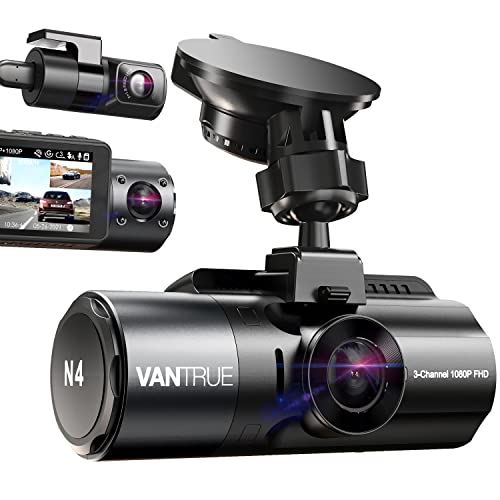


Frequently asked questions
What is the best true 4K dash cam for the price?
The REDTIGER F7NP at $149.98 and the REDTIGER 4K STARVIS 2 Dashcam at $119.99 both record true 4K on a STARVIS 2 sensor and include a memory card, making them the best value entry points into 4K dual-channel recording currently in this category.
Does a 4K dash cam need a special memory card?
Yes. A 4K stream runs at roughly 32 Mbps, which is well above what many standard consumer microSD cards can sustain for continuous recording. Use a card explicitly rated as high-endurance or for dash cam and security camera use, and size it at least 128GB to get a reasonable number of hours before the loop overwrites old clips.
Is 4K on the rear camera necessary?
Not usually. Following vehicles are typically much closer to the rear camera than the objects a front camera needs to resolve, so 1080p or 2K is normally enough on the rear channel. Several strong 4K dash cams, including the THINKWARE ARC900, deliberately keep the rear channel at a lower resolution to manage total bitrate.
How many hours of 4K footage fits on a 128GB card?
A single 4K front channel alone, at about 32 Mbps, holds roughly 11 hours on a 128GB card. Adding a 1080p rear channel raises the combined bitrate to about 42 Mbps and shortens that to roughly 6.3 hours before the loop starts overwriting the oldest footage.
What is the difference between a STARVIS 2 sensor and a regular 4K sensor?
STARVIS 2 is a specific Sony sensor generation known for improved low-light and high-dynamic-range performance compared to older sensors at the same resolution. A camera can record at 4K using an older sensor and still look worse at night than a lower-resolution camera using a STARVIS 2 sensor, which is why the sensor name matters as much as the resolution number.